Haimaz!
“Home!”
The helmsman’s cry rippled down the line of ships.
And there, at the head of the bay, Harðulaz revealed itself. It was not merely a farm. It was a scar of civilization cut into the wild earth. Boathouses stood in rows, massive timber structures large enough to swallow these longships whole. Smoke rose in thick columns from multiple smithies, the scent of charcoal and roasting ore drifting over the water.
But it was not the fields of yellowing grain or the cattle pens that made Hroðigaizaz’s stomach turn to ice. It was the mounds. Great green domes of earth rose from the fields, clustering near the water’s edge. They were immense, unnatural hills where the ancestors of this lineage sat in darkness, watching the living.
“They see us,” Hroðigaizaz thought. “This kin is old. Older than mine. Their dead guard the shore.”
The ship glided toward the shallow gravel beach.
Arunz inn!
“Oars in!”
The sound of wet timber sliding over the lashed rim. The keel kissed the bottom. A long, grinding scream of gravel against oak.
Men leaped into the waist-deep water to steady the hull. Hroðigaizaz was hauled up from his bench by a rough hand. His legs, stiff from hours of cramping cold, refused to hold him. He tumbled over the upper strake and splashed into the freezing sea. The shock stole the breath from his lungs.
On the beach, the hird was assembled. These were not a ragtag flock of farmers called to a levy. These were men in uniform cloaks, their shields painted in identical quarters of red and white. The sound of Harðulaz assaulted his ears—the clang of hammers, the lowing of cattle, the chatter of hundreds of people.
It smelled different here. Not just fish and woodsmoke, but iron. The sharp, metallic tang of bog ore and coal.
Hroðigaizaz shivered, the water soaking his tunic dragging him down. He looked up at the longhouse. It was monstrous, a timber beast built to impress both gods and men. He felt small. Dirty. His father, Hroðar, had been a fool to think he could challenge this.
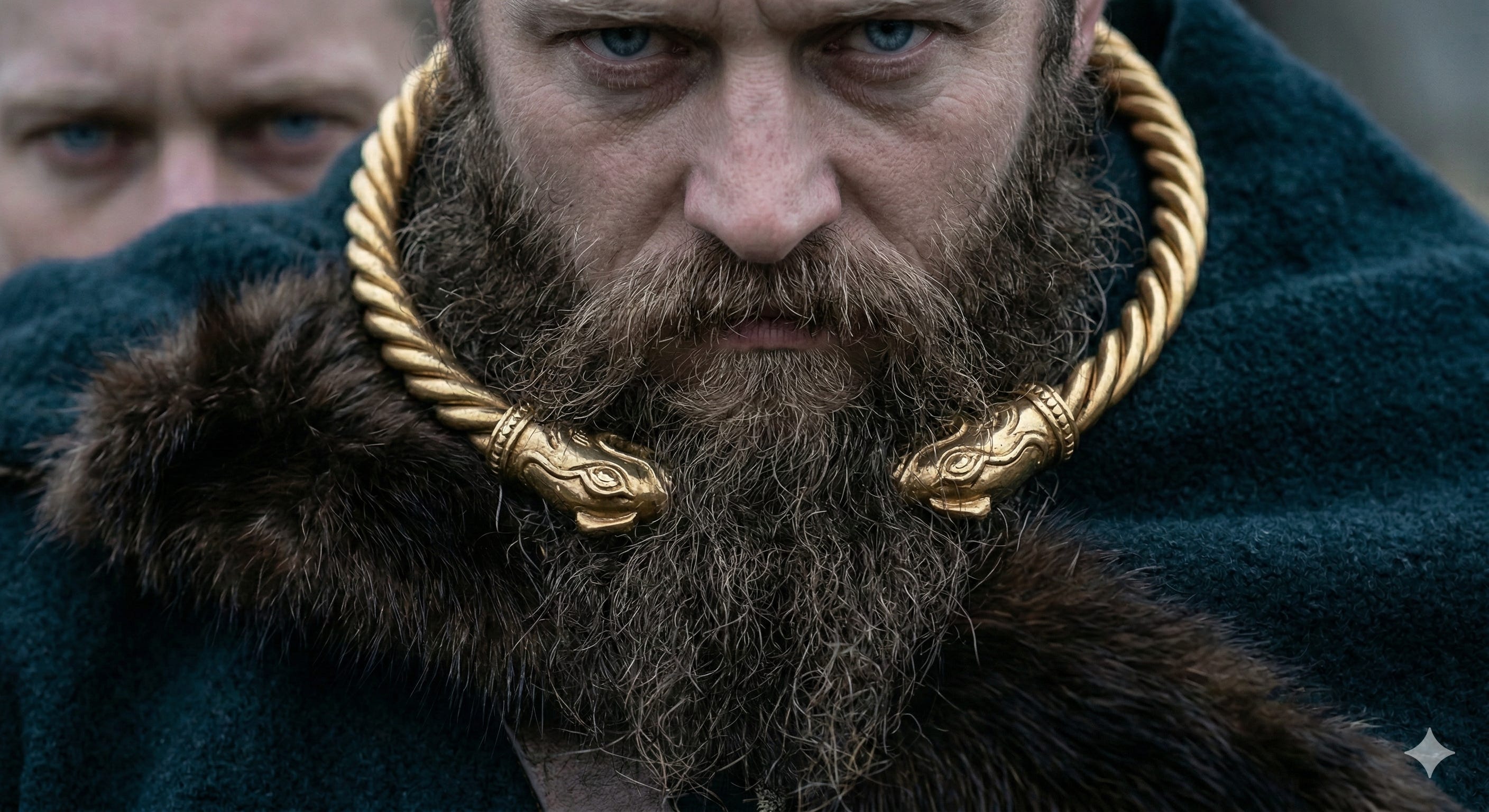
A man walked down from the ramparts. He wore a cloak trimmed with marten fur, and around his neck hung a heavy gold torque that caught the pale sunlight. This was Waduwarijar. The King of Harðulaz.
He stopped before the prisoners. His face was a landscape of weather-beaten skin, but his eyes were clear, pale blue like glacier ice. He walked past the weeping women without a glance. He stopped at the men.
“Sort this,” Waduwarijar said softly to his lieutenant. His voice was bored. “Keep those who can row. The wounded... give them to the wolves.”
Hroðigaizaz straightened his back. The pain in his shoulder flared, white-hot, but he locked his jaw. He forced his eyes to meet the chieftain’s gaze. He would not look down. To look down was to die.
Ek Hroðigaizaz.
“I am Hroðigaizaz, son of Hroðar of Alrekstadiz.”
He pitched his voice deep, trying to summon the authority of a king’s heir, trying to sound like the man he had not yet become.
Waduwarijar looked at the boy. He saw the bruises, the shivering, the fear masked by pride. He also saw the strong chin with bits of wool that would some day be a beard. He saw Hrodi’s height and wide shoulders.
“Hroðar’s whelp,” Waduwarijar said. It was not a question. “Your father intended to kill me.”
“He paid with his life,” Hroðigaizaz replied. His voice cracked. He cleared his throat and tried again. “The debt is paid.”
Waduwarijar smiled, but the ice in his eyes did not melt.
“Debt?”
“Your father tried to steal my luck. My hamingja,” the chieftain said, tapping his chest. “Such theft is not paid for with a simple death.”
The king drew a knife from his belt. The blade was short, functional, and very sharp. Hroðigaizaz tensed his muscles, preparing for the bite of steel.
“Let me bear your mark,” Hroðigaizaz said, desperation making him bold. “Or send me South. I can die with a weapon in my hand.”
Silence fell over the courtyard. Some of Waduwarijar’s men chuckled, low and mocking, but the chieftain raised a hand. He spoke loudly, for the benefit of the audience.
“You wish to serve me? The man who burned your inheritance?”
Waduwarijar stepped closer, smelling of expensive oil and old blood.
“A man who sells his honor so easily, I can never trust. And a man who lies to get a weapon in his hand is a worm.”
He sheathed the knife. A cruel glint lit up his face.
“The South is for men who seek gold and glory. The Romans pay well for sword-arms,” Waduwarijar mused. “You dreamed of that, didn’t you?”
Hroðigaizaz did not answer. His throat was dry as dust.
“No,” Waduwarijar whispered. “I will not send you to the sun.”
He leaned in, his voice a low r/umble like distant thunder.
“I send you where men disappear.”
Hroðigaizaz felt the cold spread from his stomach to his fingertips.
Norþr.
“North.”