Rō.
The oars bit the water.
Rō.
The boat was his father’s. He knew every plank of her. She was broad in the beam and shallow-drafted. Her strakes sewn together with split spruce root through holes bored along each overlapping edge. The seams packed with tarred wool that Hroðigaizaz himself had helped caulk two winters past, kneeling in the cold mud.
He remembered complaining. His father had cuffed him. Without anger. A blow the way you correct a dog that does not yet understand what it is being taught.
The boat flexed, working with the swells, the planking breathing along its sewn seams. Alive. He could feel it through the planks where he sat in the bottom of the boat. The give. The conversation between timber and water. Around him, the thralls rowed. His hands were still tied behind his back.
They were his father’s thralls. He had known their faces his whole life: Ósk, who smelled of the pig-pens he tended. The two brothers from the east whose names he had never learned to say correctly. The old man, Grimaz, who had been taken in a raid before Hroðigaizaz was born. They did not look at him.
He was cargo now, the same as them. The same as the sheep penned at the prow, the smell of wool drifting back with the wind.
His father’s sheep. His father’s boat. His father’s thralls.
All of it belonged to the men of Harðulaz now. Eira too. She was in another boat ahead of them.
The fjord was dark. The sky above was grey and the mountains to the east had swallowed the dawn. There was no warmth in the air, only the promise that warmth had once existed and might, in time, exist again. His tunic was drying.
He did not think about his father. He thought about the sun.
He thought about what he knew of it, which was what every man in Alrekstadiz knew: that it moved. That it moved from east to west, and that south of the mountains and south of the sea the days were long and the earth was different. He had heard this from traders.
Men who came up the coast with soft leather goods and strange beads of coloured glass, who spoke with accents that made the familiar tongue sound like a foreign language. They told stories the way men do when they know their stories are the most valuable thing they carry: slowly, with pauses, watching to see what the listener would offer.
He had listened. He had always listened. His father’s hall had been a place where listening was taught by example, where his father sat at the high seat and weighed every word spoken to him before spending one of his own.
But his father had not listened to the traders’ stories about Rome. His father had poured their wine, taken their beads, sent them south again, and turned back to the fjord, to the cold, to the ordinary wars of the coast.
That was his mistake, Hroðigaizaz thought. One of many.
He had heard the stories. The city that had swallowed the world. Roads of flat stone running from one end of the earth to the other, straight as a thrown spear, so that an army could march from morning to night and never lose its way. Walls so tall that men standing at their feet looked like children. And the emperor — the man who sat at the centre of it all like a spider at the hub of an enormous web, except that spiders were patient and quiet and this man, by all accounts, was neither.
Constantinus. That was the name the traders used. They said it with a particular weight, the way you say the name of a god or a powerful chieftain when you are not certain how much distance you need to keep from it.
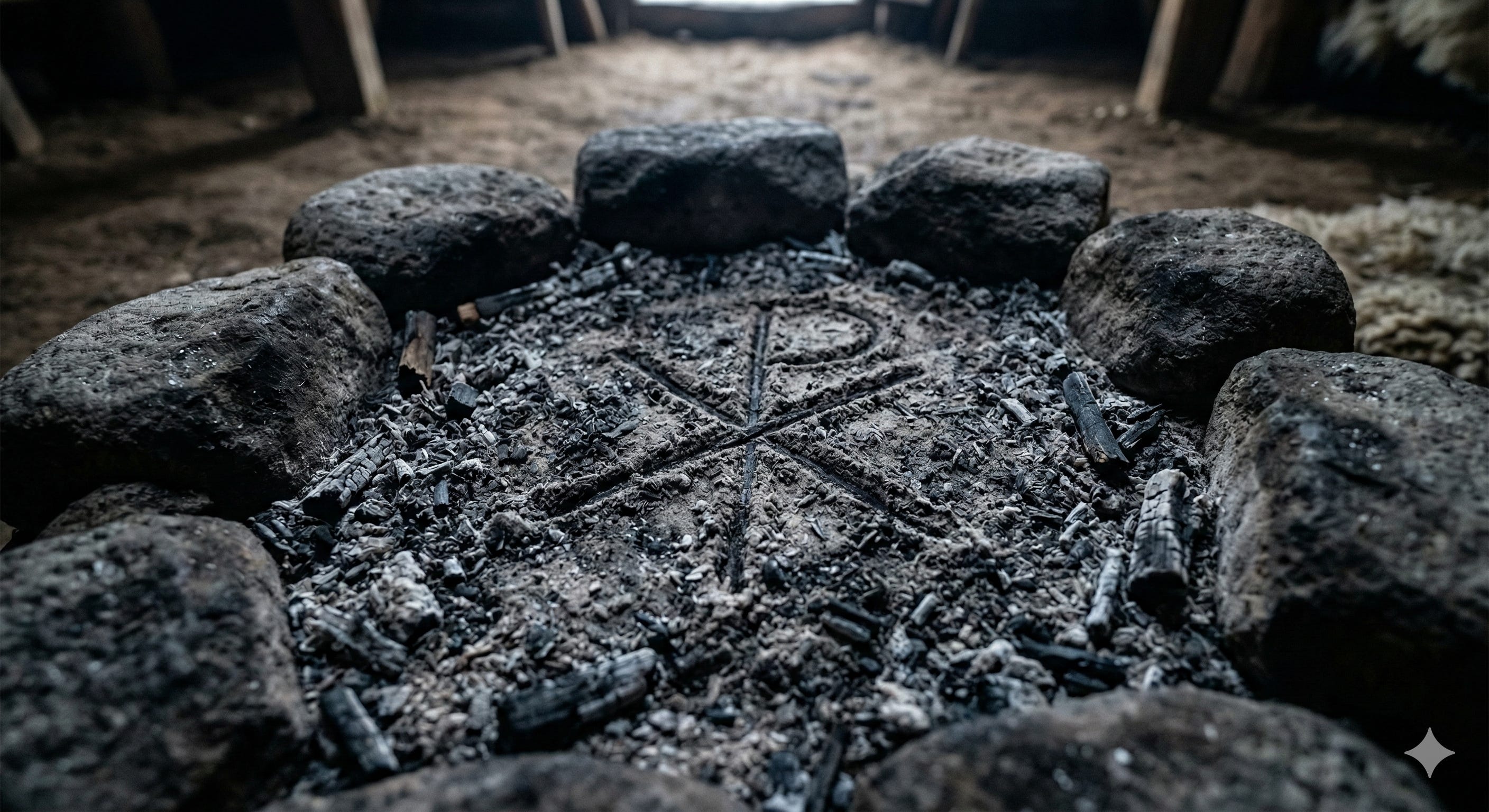
He had a god too, this emperor. A new god, or so the traders said, though gods were rarely new. Usually they were old gods in new clothing, the same hunger wearing a different face. This god had a symbol. The traders had drawn it in the ashes of the hearth: two lines, one straight, one curved, crossed and layered. The sign the emperor’s soldiers painted on their shields.
Chi. Rho.
But he had looked at the mark in the ashes of his father’s hearth and felt something he could not name. Not piety. Not belief. Something colder and more practical. The mark of a man who had decided what he served and then conquered half the world behind it.
An army marches better when it knows what it fights for, one of the traders had said, and his father had grunted and refilled his cup, and Hroðigaizaz had stored the sentence away in the silent archive he kept, the one place in himself he had never shown anyone.
Rō.
The oars. The water.
Grimaz, the old thrall, was watching him now. The old man’s face was unreadable, grooved deep by decades of salt and cold. He had been a free man once. Somewhere,
Hroðigaizaz looked away. He looked south.
The fjord ran roughly north to south here, and the pale smear of the sky was brightest in the south, where the sun was climbing somewhere behind the clouds. He knew, with the knowledge in his bones like any other man of the coast, that Rome lay south and east. South and east, across the grey water, across the lands where the trees grew tall and thick, across rivers he had no names for.
“Chi Rho!”
He said the words out loud. As if to summon the god he did not know. His eyes followed the path of the wake of the boat. He looked as the sun god peeked through the cloud and covered the hills behind them with golden light. He knew his course. His direction. It was calling him.
“Chi Rho!”